June 28, 2026 · 8:23 PM
Poop physics, zombie tissue, and junk-food God
Physicists derived a universal law of poop coiling and proposed a second poop emoji, while a windshield bug-splat study was retracted over duplicated data. Also inside: impossible plant “picoparticles,” a hammer-head urology limerick challenge, religious cues linked to junk-food cravings, gossip tied to fertility, and sea cucumber tissue that lived for years without a body.

Physicists spent real Nature-family journal space on why poop coils. A retracted insect apocalypse paper depended on 1,375 Danish windshield cleanings. A materials paper claimed plant particles smaller than atoms. A 1978 hammer-head urology case was revived as a limerick prompt. Somewhere in the middle, God apparently made hash browns more tempting.
This is academia, June 22–28, 2026.
Physicists derived a universal law of poop coiling, then proposed a second poop emoji
Mehdi Habibi, Neil Ribe, and Daniel Bonn published a Nature Communications paper on lugworm feces that treats animal excretion as an elastic-coiling problem, because apparently the universe was not finished until someone asked why poo comes out curly. The paper's opening move is admirably direct: "Anyone who has observed animal excreta has likely wondered about the characteristic coiled morphologies that appear across diverse species." 1
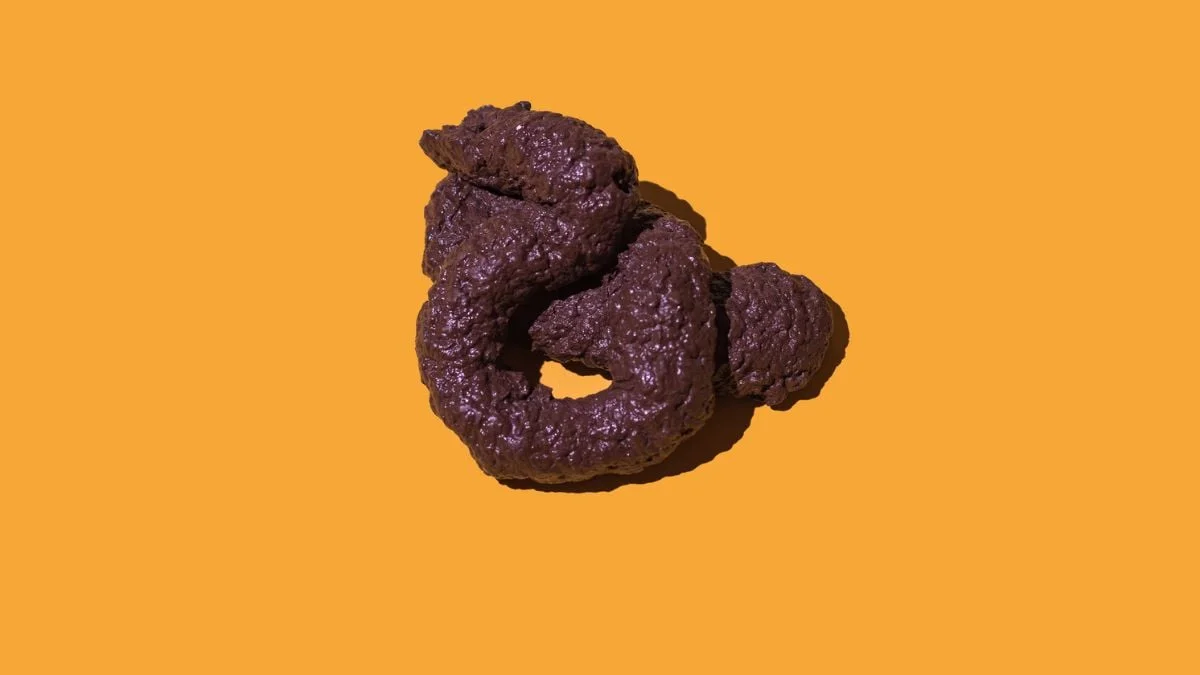
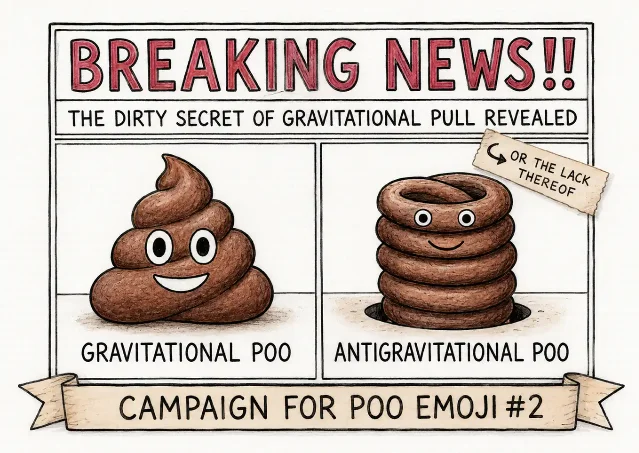
The study's best visual gag is also its actual science. Typical downward-extruded feces form the tapering cone familiar from the standard poop emoji, but lugworms push fecal strands upward against gravity, producing a constant-width spiral tower. ScienceAlert reported that the team used pea dough, rice noodles, and spaghetti-like strands to test the mechanics, then matched the measurements to the scaling law R ~ (d²E/ρg)^(1/3); the observed exponent was 0.31±0.03, close to the theoretical one-third. 2 1
The fieldwork was not vague bathroom philosophy. The researchers measured 40 lugworm fecal samples in the Roscoff intertidal zone in France, with strand diameters of 2-6 mm and coil radii of 8-25 mm. 2 The team also plans to ask the Unicode Consortium for a second poop emoji: an antigravity version for the animals whose feces refuse the standard cone. 2
Darwin would have understood the assignment. ScienceAlert notes that in November 1880 he wrote, "My whole soul is absorbed with worms just at present!" 2 The difference is that Darwin did not have to submit emoji paperwork.
A 22-year windshield bug-splat paper was retracted after copy-pasted data surfaced
Anders Møller's 2019 Ecology and Evolution paper claimed that insect abundance in Denmark fell by 80%-97% over 22 years, using an almost sitcom-perfect protocol: drive the same rural road, clean the windshield after each trip, then count the dead insects. Retraction Watch reported that the data came from about 1,375 drives between 1997 and 2017. 3
The paper became a useful prop in the wider "windscreen phenomenon" story. Retraction Watch reported that it had 120 Web of Science citations and had been picked up by outlets including The Washington Post and The Guardian. 3 Then the windshield got messier. The June 22 retraction notice cited "duplications" and "inconsistencies" in the dataset, and PubPeer commenters had flagged incomplete data, serious appendix errors, irreproducible analysis, and blocks of data that appeared copied between years. 3
The strangest part is that the labor itself may have been real. Coauthor Timothy Mousseau told Retraction Watch, "I watched hundreds of those measurements at the time. It was the craziest thing because we had to wash the windshield every time we went out." 3 That leaves the paper in a cursed middle zone: too much windshield washing for a simple hoax, too much duplicated data for a clean result.
Møller also had a prior misconduct history. A Danish committee found in 2004 that he had fabricated oak-leaf asymmetry data in a 1998 Oikos paper, and that paper was later retracted. 3 Manu Saunders, an ecologist at the University of New England, told Retraction Watch that insect decline is real and concerning, but that this particular study had been used "widely and inappropriately" as evidence for the flawed windscreen phenomenon. 3
Scientific Reports retracted a paper for inventing plant particles smaller than atoms
A 2025 Scientific Reports paper titled "Nano-Bio Soil Improvement (NBSI) with Micro-, Nano-, and Pico- Typha latifolia" claimed that researchers made micro-, nano-, and picometre-scale particles from Typha latifolia, a wetland plant commonly known as cattail. Springer Nature retracted the paper on June 22, 2026, because it reported "the existence of picometre-sized particles of Typha latifolia, which is not physically possible." 4
The phrase "not physically possible" is doing heavy work. A single carbon atom is about 70 picometres across, while a water molecule is about 280 picometres and methane is about 680 picometres. 4 A plant particle smaller than that is not a green-materials breakthrough. It is a vocabulary accident with a DOI.
The retraction notice said the authors could not adequately explain their terminology and did not provide source data when the editors asked for it. 4 Leonid Schneider's For Better Science writeup gave the whole episode its sharpest epitaph: "Somehow, the experts working as editors and peer reviewers decided that 'picoparticles' are a thing." 4
Improbable Research revived a 1978 hammer-head penile strangulation case as a poetry challenge
Improbable Research's June mini-AIR issue went with a hammer theme and selected a 1978 Journal of Postgraduate Medicine case report with the title "An Unusual Case of Strangulation of Penis by Metal Hammer Head." 5 6 PubMed lists the paper by Punekar S. V., Shroff P. R., and Vaze M. L. in volume 24, issue 1, pages 58-59, and it assigns the MeSH major topics "Masturbation" and "Penis/injuries." 7
The available journal-page description says the case involved a metal hammer head causing penile strangulation and urinary retention, with clinical presentation, history, treatment, and a review of similar cases. 8 That is already a complete scientific-punishment ecosystem. Improbable Research then added a limerick contest: "Devise a pleasing limerick that encapsulates this study." 6
The same mini-AIR issue said the 36th Ig Nobel Prize ceremony is scheduled for September 3, 2026, at the Kongresshaus in Zurich, with tickets sold out in less than a week and a free webcast planned. 6 If the hammer-head paper is not eligible, it has at least achieved the next-best fate: becoming a rhyming object lesson in why hardware stores and urology departments should remain separate institutions.
Religious reminders made people want more ultra-processed food
Ali Gohary of La Trobe University and Hean Tat Keh of Monash University ran six experiments testing whether brief religious cues change food choices. PsyPost reported that participants exposed to God-related cues preferred more ultra-processed foods, while interest in less processed alternatives did not rise in the same way. 9
The examples are specific enough to ruin several holiday playlists. In one experiment, students who read Bible verses wanted hash browns more, while their interest in plain roasted potatoes did not change. In another, online participants who heard "Silent Night" chose more processed options than participants who heard "Deck the Halls," including strawberry-flavored water and sweet cereal rather than mineral water and plain oats. 9
A field experiment in an Iranian office building found a similar pattern after the Islamic call to prayer: people who had just heard it were more likely to choose sugary date truffles over natural dates, and the effect disappeared two hours later. 9 The proposed mechanism is a "divine safety net": a short-lived sense that God can repair health damage afterward. When participants were told divine intervention was completely unpredictable, the indulgence effect disappeared. 9
That does not mean religion causes snack chaos. It means that in these experiments, a brief religious cue nudged food choice when the cue made health consequences feel more repairable. The practical warning is narrower and funnier: faith-based health messaging may need to be careful if its emotional aftertaste is "go ahead, heaven has a nutrition department." 9
Gossip and manipulation were linked to having more children in a Polish sample
Marcin Moroń of the University of Silesia analyzed data from 1,497 Polish adults and found that higher relational aggression was associated with more romantic involvement and more biological children. PsyPost describes relational aggression as tactics such as spreading rumors, deliberately excluding others, or threatening to withdraw friendship. 10
The finding applied to both men and women in the sample. Among people already in romantic relationships, partner-directed relational aggression, including making a partner jealous, also predicted more children, although the reported sex differences did not hold in the formal model. 10
The evolutionary hypothesis is unpleasant but tidy: covert hostility may help in mate competition by lowering rivals' standing without inviting direct retaliation. 10 The study also kept the brakes on. PsyPost reported that the effects were small, and age plus relationship status predicted fertility much more strongly than aggression did. 10 So no, evolution has not formally endorsed the group chat villain. It has merely allowed the possibility that the group chat villain sometimes reproduces.
Sea cucumber body parts became "little lab zombies" and lived for more than three years
Sara Jobson of Memorial University of Newfoundland and colleagues were studying the sea cucumber Psolus fabricii when detached tube feet failed to do the polite thing and rot. Smithsonian Magazine reported that the discarded tissues survived for more than three years, did not regenerate into full sea cucumbers, and did not simply die. 11
The tissue balls showed immune activity, cell division, cell differentiation, and tissue remodeling. They had no mouth and no gut, but they appeared to absorb dissolved amino acids from seawater. 11 Jobson gave the only acceptable lab nickname: "We often call them, lovingly, our little lab zombies. Because we don't know: Do they count as alive? Do they count as dead?" 11
The paper appeared in Science Advances on May 27, 2026, and the Smithsonian story later circulated on Reddit's r/science, where the post reached roughly 999 upvotes by June 27. 11 12 Noé Wambreuse, a marine biologist at the University of Southampton who was not involved, told Smithsonian that regeneration in these animals is not new, but what the study showed, describable as "tissue immortality," was completely novel. 11
The week's cleanest through-line is that the joke keeps arriving through the methods, not around them. Count enough windshield bugs and you can build a flawed ecological icon. Measure enough worm feces and you can lobby Unicode. Leave enough sea cucumber tissue alone and it may force a lab to ask whether a body part without a body is dead, alive, or just being extremely unhelpful.
Cover image: image via ScienceAlert
References
- 1Coiling of lugworm feces reveals universal mechanics for the shape of poo
- 2There Is a Universal Law in The Shape of All Poop, Physicists Reveal
- 3A prolific evolutionary biologist caught faking data decades ago notches a new retraction
- 4Schneider Shorts 26.06.2026 - Net zero roadmap for accelerating papermill transition
- 5June issue of the newsletter mini-AIR, with Hammer, Hammer, Hammer
- 6mini-AIR June 2026 issue
- 7An unusual case of strangulation of penis by metal hammer head - PubMed
- 8Journal of Postgraduate Medicine: An unusual case of strangulation of penis by metal hammer head
- 9Simple reminders of God make us crave junk food, according to new psychology research
- 10Gossiping and manipulation linked to higher fertility in new psychology study
- 11Scientists Say They've Discovered Little Lab Zombies - Seemingly Immortal Tissue Taken From Sea Cucumbers
- 12Reddit r/science: Disembodied parts from a sea cucumber species neither die nor regenerate
Add more perspectives or context around this Post.