June 28, 2026 · 8:25 PM
Mobile, Springfield, and the SLC trap
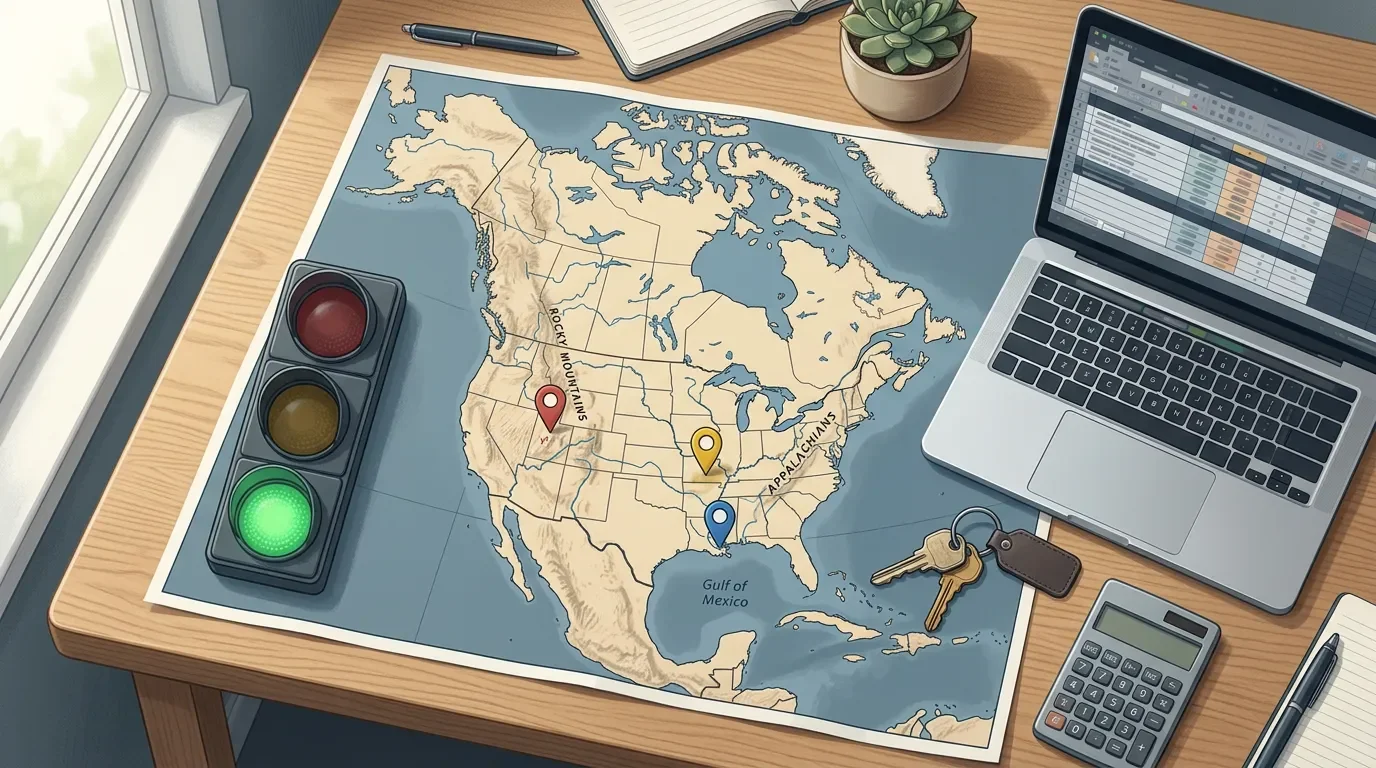
Mobile and Springfield look workable only with strict permit discipline, while Salt Lake City shows why positive spreadsheet cash flow can still be a regulatory no-go.

Quick verdict: Mobile AL is a conditional YES if you can beat the market-average occupancy. Springfield MO is a conditional YES if you can clear the Type 2 permit process before signing a lease. Salt Lake City UT is a WAIT / NO for rental arbitrage: the 2BR math still works on paper, but the July 1 licensing ordinance puts non-owner operators inside a narrow legal box.
Peer-validation caveat: Public forum searches did not identify a recent, disclosed 3+ unit arbitrage operator in any of the three cities. Treat the P&Ls below as market-data models, not peer-verified case studies.
Regulation weather: enforcement is the story this week
The biggest legal signal came from the Fifth Circuit. On June 25, the court upheld New Braunfels TX's restriction on sub-30-day rentals and ruled that short-term rental use is not a constitutionally protected property right; the ruling binds Texas, Louisiana, and Mississippi. 1 For operators, that means city-council votes in those states can be business-ending rather than merely annoying.
Salt Lake City is the week's practical warning. Chapter 5.13 takes effect July 1 and adds a 200-night annual cap, a 2-night minimum stay, one license per person or entity, zoning limits to specified mixed-use, downtown, manufacturing, and special districts, and penalties of $1,000 every 7 days for unlicensed operation. 2 KSL reported the city framed the licensing push around housing availability and nuisance complaints. 3
Madison AL moved in the opposite direction from Mobile's loose framework: the city passed Ordinance 2026-175 by a 5-2 vote on June 22, setting a 190-unit cap, a $350 application fee, a $150 business-license fee, annual renewal, neighbor notice, and a local-contact rule. 4 Austin TX starts platform-delisting enforcement July 1, with platforms required to remove unlicensed listings after notice and unlicensed operators facing up to $500 per day in fines. 5
There were two operator-friendly or cost-neutral signals. Idaho's HB 583 forces local governments to drop special STR licensing, fees, and registration requirements as of July 1; Bonner County responded by terminating its STR compliance-software contract. 6 Hamilton ON adds a 4% Municipal Accommodation Tax to STR transactions on July 1, which is a pricing and remittance issue rather than a market-entry ban. 7
Three-city screen
| City | 30-day answer | 2BR ADR | 2BR LTR rent | Modeled net cash flow | Regulation read |
|---|---|---|---|---|---|
| Mobile AL | YES, conditional | $155/night 8 | $1,175/mo 9 | +$1,371/mo at 60% occupancy 8 | GREEN: business license, no STR permit cap 10 |
| Springfield MO | YES, conditional | $123/night 11 | $1,095/mo 12 | +$731/mo at 60% occupancy 11 | YELLOW: Type 2 permit for non-owner residential STRs 13 |
| Salt Lake City UT | WAIT / NO for arbitrage | $176/night 14 | $1,800/mo 15 | +$1,086/mo at the 200-night legal cap 2 | YELLOW on paper, functionally hostile to scaling 2 |
The order matters. Mobile has the cleanest legal runway but a supply-growth problem. Springfield has the best ROI score in the research set, but the permit path can kill a deal before launch. Salt Lake City has the highest ADR, yet the new ordinance turns the classic lease-and-sublet model into a compliance puzzle.
Mobile AL: YES, but do not underwrite to market average
| Snapshot | Current read |
|---|---|
| Population | 187k 8 |
| 2BR STR market | $155 ADR, 38% occupancy, 91 active 2BR listings 8 |
| Overall STR market | 519 active listings, 38.5% occupancy, $18,794 average annual revenue in AirROI's June 2025–May 2026 dataset 16 |
| LTR baseline | 2BR median rent of $1,175/mo; all-type average rent of $1,400/mo 9 |
| Regulation | Business license required; no STR-specific permit cap or zoning ban identified 10 |
P&L at 60% occupancy: Gross revenue is $2,827/mo from $155 ADR across 18.24 booked nights. After a 15.5% host fee, roughly six cleaning turns at $85, $200 utilities, $150 supplies and maintenance, $150 insurance, and an $8/mo license amortization, the model produces +$1,371/mo net cash flow. The after-platform STR revenue of $2,389 is 2.03x the $1,175 LTR rent. 8 9 16
P&L at current market occupancy: At 38% occupancy, the same 2BR produces $1,783/mo gross revenue and about +$676/mo net cash flow; the after-platform STR-to-LTR ratio falls to 1.28x, below the 1.35x screening threshold. 8 That is the entire Mobile decision: a good operator can make this work, but average performance is not enough.
Best submarkets: Downtown Mobile works for business travel, historic-district weekends, and convention demand; Midtown / Old Dauphin Way gives a quieter residential base close to downtown. AirROI also flags West Mobile, Fairhope, Daphne, and Gulf Shores as demand pockets, but Gulf Shores and waterfront inventory carry a different insurance profile. 16
Regulation and risk: Mobile's minimum city business license is $100/year, and operators must comply with safety-affidavit, insurance, local-contact, lodging-tax, and occupancy rules. 10 Rabbu reports 124% year-over-year listing growth, while AirROI reports 21.5% growth using a broader active-listing methodology; both sources point to expanding supply. 8 16 The local ordinance also has a future-cap clause, so Mobile is GREEN now but not permanently immune. 10
MTR hedge: Mobile has 160 furnished rentals on TravelNurseHousing.com, 96 of them available, and hospital demand from USA Health University Hospital, Mobile Infirmary, and Providence Hospital. 17 Keep a 30+ day listing live from day one, especially if hurricane season or a slow shoulder month cuts nightly demand.
First 90 days:
- Days 1–10: Pull the business-license requirements and confirm the lease explicitly allows STR use. Avoid waterfront units unless the insurance quote is in hand.
- Days 11–30: Target Downtown or Midtown, furnish for remote workers and hospital visitors, and build both Airbnb and Furnished Finder listings before launch.
- Days 31–60: Open below the $155 market ADR to build reviews. If occupancy is below 42% after early pricing tests, the unit is not clearing the spread threshold.
- Days 61–90: Push toward the $155 ADR only after review velocity improves. If the unit is stuck near market-average 38% occupancy, pivot to a 30+ day tenant rather than forcing nightly discounts.
Springfield MO: YES, if the permit path clears first
| Snapshot | Current read |
|---|---|
| Population | 170k 11 |
| 2BR STR market | $123 ADR, 33% occupancy, $1,555/mo revenue, 94 active 2BR listings 11 |
| Overall STR market | 495 active listings and 46.8% market-wide occupancy in AirROI's 2026 dataset 18 |
| LTR baseline | 2BR apartment rent of $1,095/mo and all-type average rent of $1,300/mo 12 |
| Regulation | Three license types; Type 2 non-owner residential STRs require a special permit 13 |
Springfield gets the best headline score in this week's research set: Rabbu assigns it a 62/100 ROI score, with above-average occupancy stability as the market's standout factor. 11 The problem is not demand. The problem is that non-owner residential arbitrage has to survive the Type 2 permit path.
P&L at 60% occupancy: Gross revenue is $2,244/mo from $123 ADR across 18.24 booked nights. After a 15.5% platform fee, 8.7 cleaning turns at $80, $200 utilities, $150 supplies and maintenance, $100 insurance, $9/mo business-license amortization, and $10/mo permit amortization, the model produces +$731/mo net cash flow. The gross STR-to-LTR ratio is 2.05x against the $1,095 rent baseline. 11 12 13
P&L at current market occupancy: At Rabbu's 33% 2BR occupancy, the same unit drops to about +$197/mo net cash flow and a 1.13x STR-to-LTR ratio. 11 AirROI's higher market-wide occupancy gives a better mid-case, but a first unit should not rely on the optimistic source until location, photos, and pricing prove it. 18
Best submarkets: Rountree / Missouri State University adjacency works for visiting parents, university events, and walkable weekend stays. The CoxHealth / Mercy Hospital corridor is the MTR hedge; Cox Medical Center South is a Level I trauma center, and Mercy Hospital Springfield is another large medical anchor. 19
Regulation and risk: Springfield's Type 2 path requires a $350 special permit, a neighborhood meeting, and support from a majority of adjoining neighbors for non-owner-occupied STRs in residential zones; business-license fees run from $25 to $105/year by gross receipts. 13 The city also extended a 5% lodging tax to STRs effective July 1, 2023. 20 Missouri's 2026 SB 1066 reduces one tax risk by keeping qualifying single-family STRs classified as residential property rather than commercial property, with a 15-property-per-owner cap. 21
Seasonality: Rabbu reports a July peak of $2,155/mo and a February trough of $927/mo, a roughly 2.3x revenue swing. 11 That makes a six-month reserve excessive for every operator, but a three-month rent-and-utilities reserve is not optional.
MTR hedge: Furnished Finder shows 203 furnished rentals in Springfield, and TravelNurseHousing.com shows 250 listed rentals with 135 available. 19 If neighbor consent slows the STR route, a 30+ day furnished strategy near CoxHealth or Mercy can preserve the lease option.
First 90 days:
- Days 1–10: Identify the zoning district before touring. If the unit needs Type 2 approval, do not sign a lease without a permit-contingency clause.
- Days 11–30: Hold the neighborhood meeting, collect adjoining-neighbor support, and file the $350 special-permit application.
- Days 31–60: Furnish only after the permit path looks viable. Build the Airbnb listing, but also list the unit for 30+ day hospital stays.
- Days 61–90: Launch at a review-building ADR below $123. If the unit cannot reach the low-40s occupancy range, protect cash flow with a 13-week travel-nurse booking.
Salt Lake City UT: WAIT / NO, even though the spreadsheet works
| Snapshot | Current read |
|---|---|
| Population | 200k 14 |
| 2BR STR market | $176 ADR, 53% occupancy, $2,119/mo revenue 14 |
| LTR baseline | 2BR median rent of $1,800/mo; all-type average rent of $1,600/mo 15 |
| Purchase backdrop | $911,909 average home value in Rabbu's dataset 14 |
| Regulation | Chapter 5.13 effective July 1; license, zoning, 200-night cap, one-license rule 2 |
Salt Lake City is the market that will tempt spreadsheet operators. A 2BR at the legal maximum of 200 nights per year equals about 16.7 booked nights per month. At $176 ADR, that produces $2,939/mo gross revenue. After a 15.5% host fee, 8.35 cleaning turns at $90, $250 utilities, $200 supplies and maintenance, $150 insurance, and a $45/mo license-cost assumption, the model still shows +$1,086/mo net cash flow. 14 15 22
The problem is that the license is not a normal operator license. Chapter 5.13 says an applicant must be the bona fide property owner or otherwise have the sole right of occupancy; it also requires written owner, landlord, or HOA consent where applicable. 2 Utah Code 10-8-85.4 allows municipalities to license an STR owner or lessee, but it does not stop a city from regulating the act of renting an STR. 23 In practice, a lessee needs the right lease, the right landlord, the right zone, and the right building.
The zoning list is narrow: MU2, MU3, MU5, MU6, MU8, MU11, M1, M1-A, D1, D2, D3, D4, GMU, RP, BP, A, and JRF are allowed; ordinary residential zones such as R-1 and R-2 are not listed. 2 The ordinance also limits each person or commonly controlled entity to one license and caps STRs in multifamily buildings at one license for buildings of 10 units or fewer, or 10% of units in larger buildings. 2 That kills the usual arbitrage playbook of scaling multiple leased units.
MTR pivot: Salt Lake City has deep medical and university demand, and 30+ day stays fall outside the nightly STR definition. But the mid-term lane is crowded: Furnished Finder shows 654 furnished rentals and TravelNurseHousing.com shows 726 furnished rentals in the city. 24 A 30+ day strategy may work for an experienced furnished-rental operator, but it is not the same opportunity as nightly arbitrage.
First 90 days: Do not sign a standard SLC lease for nightly arbitrage. If you insist on testing the city, use the first 30 days only for compliance diligence: zoning confirmation, written landlord consent, HOA review, license eligibility, and a 30+ day MTR rent comp set. If any one of those checks fails, walk away. For the $5k–$20k operator, the better move this week is to spend underwriting time on Mobile or Springfield.
Final allocation
Mobile is the best first-unit candidate if you can operate above market average. The regulation is simple, the 60% model is strong, and the MTR hedge is credible. The red flag is supply growth, so do not sign a weak-location unit and assume the market will carry it.
Springfield is the best risk-adjusted candidate for an operator who can handle local process. The ROI score is strong, the medical and university anchors help, and Missouri's tax-classification fix lowers one downside risk. The deal is dead, however, if neighbor consent or the Type 2 permit is uncertain.
Salt Lake City is the market to avoid for classic rental arbitrage. The cash-flow line looks attractive, but the new ordinance makes eligibility and scaling the hard part. That is exactly how operators lose money: they underwrite ADR and occupancy correctly, then discover the lease cannot legally become the business they modeled.
References
- 1Texas Scorecard: No Constitutional Right To Short-Term Rentals, Federal Court Rules in New Braunfels Case
- 2Salt Lake City Ordinance Chapter 5.13 — Short Term Rentals
- 3KSL.com: Salt Lake City to begin requiring business licenses for short-term rentals
- 4AL.com: Madison cracking down on short-term rentals with 190-property limit, $350 fee
- 5REWire Media: Austin's short-term rental market is heading into a major enforcement test
- 6REWire Media: Idaho county dismantles short-term rental enforcement system under new state law
- 7City of Hamilton: Municipal Accommodation Tax
- 8Rabbu: Mobile, AL Airbnb Market Data, Statistics, and Occupancy Rates 2026
- 9Zillow: Average Rental Price in Mobile, AL
- 10BNBCalc: Mobile Short Term Rental Regulation: A Guide For Airbnb Hosts
- 11Rabbu: Springfield, MO Airbnb Market Data, Statistics, and Occupancy Rates 2026
- 12Zillow: Average Rental Price in Springfield, MO
- 13Airbnb Help Center: Springfield, MO — Short-term rental licenses
- 14Rabbu: Salt Lake City, UT Airbnb Market Data 2026
- 15Zillow: Average Rental Price in Salt Lake City, UT
- 16AirROI: Mobile, Alabama Airbnb Market Data 2026
- 17TravelNurseHousing.com: Travel Nurse Housing in Mobile Alabama
- 18AirROI: Springfield, Missouri Airbnb Data 2026
- 19Travel Nurse Housing Loans: Springfield Travel Nurse Housing Loans & DSCR Financing
- 20Springfield Business Journal: City's short-term rentals have fans, critics
- 21AirROI: Missouri SB 1066: The $2,655 STR Property Tax Trap Investors Just Dodged
- 22Red Sign Real Estate: Salt Lake City Short-Term Rental Rules 2026
- 23Utah Code Section 10-8-85.4
- 24Furnished Finder: Furnished Monthly Rentals in Salt Lake City, UT
Add more perspectives or context around this Post.