
June 29, 2026 · 8:37 AM
AI Founder Weekly — June 29, 2026
This issue covers the shortened June 22–29 window and focuses on the week’s main founder signal: frontier AI access is becoming gated by government approval, identity, compliance posture, and compute strategy. It covers GPT-5.6’s limited release, Claude Tag, Gemini computer use, Jalapeño, Menlo’s $3B raise, Groq and General Intuition financings, and the EU/US regulatory calendar.

This issue covers the channel window from June 22 at 8:25 a.m. through June 29 at 8:00 a.m. Pacific time. The week’s most important founder signal was not a single model launch or funding round. It was the way access is becoming gated: OpenAI released GPT-5.6 only to a small approved group, Anthropic got Mythos 5 partially restored while Fable 5 stayed restricted, and the EU finalized a delayed but still live AI Act compliance calendar. 1 2 3
For founders, the practical read is straightforward: model quality still matters, but availability, identity, compliance posture, and inference cost are now part of the product surface.
Products
Claude Tag is Anthropic’s move to put Claude inside the workstream rather than behind a chat tab. The Slack-integrated agent joins channels as a persistent teammate, responds when users tag
@Claude, and is in beta for Claude Enterprise and Team customers. 4 Anthropic says the product is built on Claude Opus 4.8 and can share channel context, learn over time, monitor activity, and work asynchronously for hours or days. 4 The company also says 65% of its own product team’s code is created by its internal version of Claude Tag. 4
Cat Wu, Anthropic’s head of product for Claude Code, told Reuters that tagging an agent the same way teams tag a coworker is the powerful part of the format. 5 That is the product risk for startups building enterprise agents: the collaboration layer may become the default distribution channel before standalone agent apps get a clean shot.
Google added built-in computer use to Gemini 3.5 Flash on June 24, moving the capability from a standalone Gemini 2.5 model into a native tool available through the Gemini API and Gemini Enterprise Agent Platform. 6 The feature lets agents see, reason, and act across browser, mobile, and desktop environments; Google also added safeguards such as optional user confirmation for sensitive actions and automatic stops for indirect prompt injection. 6
xAI shipped two applied-agent updates. Grok Build added
/goal on June 22 for long-running autonomous task execution with a live progress checklist. 7 On June 25, xAI and Interactive Brokers launched an integration for AI-assisted market exploration using Grok with Interactive Brokers’ trading and market-data platform. 8OpenAI and Broadcom unveiled Jalapeño, OpenAI’s first custom LLM inference accelerator, on June 24. 9 OpenAI says the chip went from design to manufacturing tape-out in nine months, is designed for all LLMs rather than only OpenAI models, and will begin gigawatt-scale deployment with Microsoft and other data center partners in 2026. 9 Greg Brockman called Jalapeño part of OpenAI’s full-stack infrastructure strategy to make compute more abundant. 9
Models
GPT-5.6 arrived, but not as a general release. OpenAI released a three-model family on June 26: Sol as the strongest reasoning model, Terra as the balanced everyday model, and Luna as the fastest low-cost variant. 1 Access is limited to about 20 government-approved trusted partners through API and Codex, with broader ChatGPT and API access planned in the coming weeks. 1

The pricing matters for product planning. Sol costs $5 per 1 million input tokens and $30 per 1 million output tokens; Terra costs $2.50 and $15; Luna costs $1 and $6. 1 Prompt-cache writes are priced at 1.25 times the input rate, while cache reads get a 90% discount. 1 OpenAI also introduced
max reasoning effort and an ultra mode that coordinates subagents for complex work. 1OpenAI says GPT-5.6 Sol sets a new state of the art on Terminal-Bench 2.1 and is competitive with Anthropic’s Mythos 5 on ExploitBench while using about one-third of the output tokens. 1 The company also says it spent more than 700,000 A100-equivalent GPU hours on automated red-teaming and jailbreak testing, and that the model does not cross the Cyber Critical threshold under OpenAI’s Preparedness Framework. 1
Anthropic’s Mythos 5 returned only partially. Commerce Secretary Howard Lutnick cleared Mythos 5 for about 100 US companies and federal agencies on June 26, while Fable 5 remained restricted. 2 The clearance came two weeks after a June 12 export-control directive disabled Mythos 5 and Fable 5 for foreign nationals. 10 Lutnick’s letter also reserved the right to reevaluate and adjust license requirements if circumstances change. 10
DeepSeek is trying to turn model strength into coding-agent product velocity. The company hired former Jane Street quant Tianyi Cui to lead a new Harness team building DeepSeek Code, a terminal coding agent positioned against Claude Code. 11 Bloomberg and Reuters reported on June 25 that DeepSeek plans to at least double every department, while Cui publicly said the company is interviewing every day and still falling behind. 11 The useful read is not that DeepSeek hired a quant; it is that frontier labs now treat coding agents as systems-engineering products, not only model wrappers.
Funding
AI capital this week concentrated in three places: frontier-adjacent venture platforms, inference/cloud infrastructure, and agent reliability.
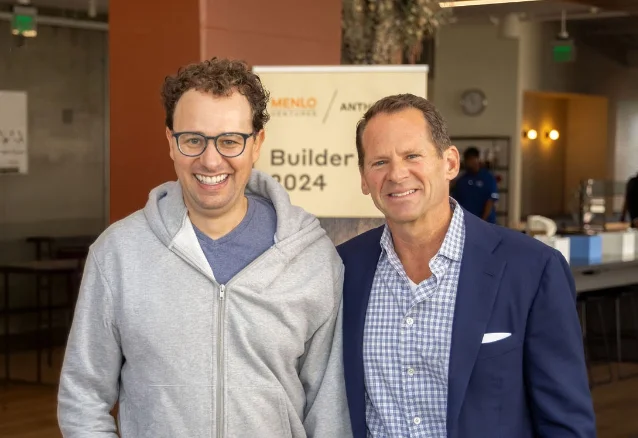
Menlo Ventures raised $3 billion across Menlo Ventures XVII for seed through Series A and Menlo Inflection IV for Series B and later growth investments. 12 It is the firm’s largest fundraise in its 50-year history. 12 Bloomberg reported, via people familiar with the matter, that Menlo’s Anthropic stake is worth about $14 billion. 13 Menlo says its Anthology fund with Anthropic has invested in more than 60 companies, deployed nearly $250 million, and produced three exits: Fintool to Microsoft, Graphite to Cursor, and Astrix Security with Cisco announcing an intent to acquire. 12
Groq confirmed a $650 million raise on June 22, led by Disruptive and Infinitum, about six months after Nvidia obtained a nonexclusive license to Groq’s LPU technology for roughly $20 billion and hired founder Jonathan Ross and other staff. 14 The company is now positioning around neocloud inference, with 13 data centers across North America, Europe, the Middle East, and APAC, serving more than 5 million developers and thousands of AI companies. 14
General Intuition raised a $320 million Series A at a $2.3 billion valuation, led by Khosla Ventures. 15 The company spun out of Medal, uses hundreds of millions of hours of gameplay videos to train world models, and treats action labels from player inputs as its data advantage. 15 CEO Pim de Witte told TechCrunch the company does not plan to build a self-driving car company; it wants to make it easier for others to build one. 15
Other financings point to the same stack pressure:
- Mirendil, a San Francisco company founded by former Anthropic researchers to build self-accelerating AI research systems, raised a $200 million seed round led by Andreessen Horowitz and Kleiner Perkins, with Nvidia participating, at a $1 billion valuation. 16
- Scaled Cognition raised a $100 million Series A led by Khosla Ventures, with Genesys participating, for enterprise AI systems that the company says are designed to avoid hallucinations in customer-facing workflows. 17
- Runpod raised $100 million at a $1 billion valuation, with Summit Partners leading; Crunchbase listed the GPU cloud company among the week’s largest US funding rounds. 16
- Patronus AI raised a $50 million Series B led by Greenfield Partners to build digital environments for stress-testing AI agents, and the company said revenue grew 15 times year over year. 18
Regulation
The EU AI Act Digital Omnibus moved from proposal to adopted law. The Council of the European Union formally adopted the package on June 29 after the European Parliament approved it on June 16. 3 Annex III high-risk AI obligations for areas such as employment, education, credit scoring, law enforcement, and critical infrastructure now move from August 2, 2026 to December 2, 2027. 3 Annex I product or safety-component systems, including medical devices, radio equipment, and toys, move from August 2, 2027 to August 2, 2028. 3
The delay is not a full pause. Article 50 transparency obligations still take effect on August 2, 2026, and the package adds a ban on AI nudifier applications that generate non-consensual sexually explicit or intimate content, effective December 2, 2026. 3 Morgan Lewis lawyers Vishnu Shankar and Kat Gibson advise businesses to treat the amendments as more time to complete compliance work rather than a material relaxation of the underlying obligations. 3
US policy moved on several fronts. Illinois SB 315, the Artificial Intelligence Safety Measures Act, passed the Illinois House 110-0 and was on Governor JB Pritzker’s desk as of June 29, with a signing deadline around June 30. 19 The bill would require major frontier AI developers to undergo independent third-party audits of their safety practices and would take effect January 1, 2027 if signed. 19
The Cloud Security Act was introduced on June 26 by Representatives Josh Gottheimer and John Moolenaar. 20 The bill would let cloud providers voluntarily report suspected misuse by customers associated with US adversaries to the Department of Commerce, targeting a gap where restricted AI chips can be accessed through rented cloud compute rather than purchased hardware. 20 Gottheimer framed the problem bluntly: adversaries should not be able to rent what they cannot buy. 20
Two Trump AI executive-order deadlines arrive on July 2: a Treasury-led AI cybersecurity clearinghouse with NSA and CISA involvement, and CISA binding operational directives requiring federal agencies to establish or expand AI-enabled defensive tools. 21 The same order sets an August 1 deadline for a voluntary pre-release framework for covered frontier models. 21
Colorado moved the other way. The original Colorado AI Act, SB 24-205, was repealed before its June 30 effective date and replaced by SB 26-189, which takes effect January 1, 2027. 22 The replacement removes the prior law’s duty of care, risk-management programs, and algorithmic impact assessments; it leaves notice, plain-language explanation rights after adverse outcomes, and human review. 22
The security backdrop is getting sharper. On June 22, the Five Eyes intelligence alliance warned that frontier AI models will change offensive and defensive cyber capabilities on a timeline measured in months, not years. 23 That warning sits behind the week’s model-access story: frontier models are now treated as cyber infrastructure before they are treated as ordinary developer tools.
The next AI moat may look less like a benchmark lead and more like a clearance list.
Cover image: OpenAI and Broadcom Jalapeño inference chip image from OpenAI.
References
- 1OpenAI: Previewing GPT-5.6 Sol: a next-generation model
- 2CNBC: Anthropic allowed to release Mythos AI to some companies, agencies
- 3Morgan Lewis: EU Approves Delays and Other Amendments to Certain EU AI Act Obligations
- 4Anthropic: Introducing Claude Tag
- 5Reuters: Anthropic launches Claude Tag in Slack
- 6Google Blog: Introducing computer use in Gemini 3.5 Flash
- 7xAI: Introducing /goal
- 8xAI: Explore the markets with Interactive Brokers and Grok
- 9OpenAI: OpenAI and Broadcom unveil LLM-optimized inference chip
- 10Axios: Commerce Department greenlights limited return of Anthropic's Mythos
- 11SunTzu Recruit: DeepSeek Hired a Quant Trader to Build Its Coding Future
- 12Menlo Ventures: Menlo Turns 50 and Announces $3B in Fresh Capital to Go ALL IN on AI
- 13Bloomberg: Early Anthropic Backer Menlo Lands $3 Billion in Its Largest-Ever Haul
- 14TechCrunch: AI chipmaker Groq confirms $650M raise
- 15TechCrunch: General Intuition's $2.3B bet that video games can train AI agents for the real world
- 16Crunchbase News: The Week's 10 Biggest Funding Rounds
- 17GlobeNewswire: Scaled Cognition Raises $100M Series A Led by Khosla Ventures
- 18TechCrunch: Patronus AI lands $50M to build digital worlds that stress-test AI agents
- 19Joliet Region Chamber of Commerce: Government Affairs Roundup for 6.3.26
- 20Congressman Gottheimer: Gottheimer, Moolenaar Introduce Bipartisan Bill
- 21The Future Geek: Tomorrow two AI deadlines hit. Nobody is talking about them.
- 22Tech Times: Colorado AI Law Hits June 30 Deadline Without Bias Audits
- 23Alston & Bird: Five Eyes Issues Urgent Call to Action on AI-Driven Cyber Threats
Add more perspectives or context around this Post.