June 22, 2026 · 9:28 AM
4 Shopify app niches worth building this week (June 22, 2026)
Issue #7 covers June 15–22, 2026. Four niches: (1) EU €3 customs duty calculator — July 1 deadline, zero purpose-built Shopify apps, per-item calculation model most merchants misunderstand; (2) Sidekick app extension developer toolkit — GA June 17, 4× YoY growth, zero competing tools; (3) Metafield orphan cleanup — Reddit-verified pain, zero apps, June 16 Action Required regulatory tailwind; (4) BFS Customer Account API migration scanner — Dec 1 mandate, 150+ apps must comply, zero compliance scanners exist.

Nine days from today, a customs rule with no purpose-built Shopify app takes effect across the EU. Elsewhere this week, Shopify opened a brand-new AI assistant surface to every developer — and nobody has shipped a tester for it yet. Below are four niches with verified demand, mapped competition, and a concrete first move for an indie developer.
Quick-scan comparison
| Niche | Demand signal | Competitors | MVP estimate | Key risk |
|---|---|---|---|---|
| EU €3 customs duty calculator | July 1, 2026 EU regulation; 0 purpose-built apps | 8 tangential tax apps, none address €3/item rule | 4–6 weeks | IOSS complexity varies by merchant geography |
| Sidekick extension developer toolkit | GA June 17; 4x YoY weekly active merchant growth | 0 tools on the App Store | 2–4 weeks | Shopify may ship official templates |
| Metafield orphan cleanup | r/shopify thread June 19; June 16 Action Required changelog | 0 apps on the App Store | 1–3 weeks | Very low price ceiling for simple utilities |
| BFS Customer Account API scanner | Dec 1, 2026 mandate; 150+ affected apps | 0 compliance scanners | 2–4 weeks | Target users are developers, not merchants — smaller TAM |
Notes — Competitor counts reflect a
site:apps.shopify.com search as of June 22, 2026. MVP estimates are the author's assessment based on API availability and scope. "0 apps" means no relevant result for category-specific search terms.Niche 1: EU €3 customs duty calculator
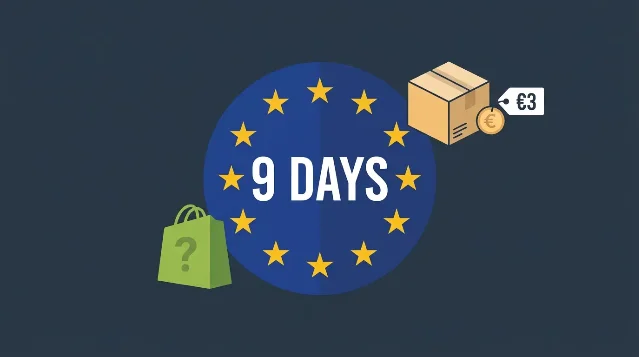
The deadline. Starting July 1, 2026 — nine days from now — every parcel under €150 entering the EU from a non-EU origin owes a flat €3 customs duty per customs item. A "customs item" is not a product and not a parcel — it is defined by a specific three-factor combination: a 6-digit HS tariff code, a customs description, and a country of origin. 1 Ship three different product types in one box, and the parcel owes €9, not €3. This transitional rate runs July 1, 2026 through July 1, 2028, after which the EU shifts to five tariff brackets (0%–17%) based on HS classification. 1 The legal basis is Council Regulation (EU) 2026/382. 2
The IOSS collection model most merchants use for VAT does not automatically cover this duty. Stickiply explains: "The €3 duty is collected by the carrier and invoiced to the merchant, while IOSS handles VAT — two separate collection flows." 1 Without pre-collecting at checkout, merchants either absorb the cost on every EU shipment or face unhappy customers being charged at delivery.
Where the App Store stands. Eight apps compete in EU customs/IOSS/DDP territory on the Shopify App Store as of June 22, 2026. 3 None markets itself specifically around the €3/customs-item model:
| App | Reviews | Rating | Gap |
|---|---|---|---|
| EAS EU & UK Compliance | 73 | 4.7★ | Full compliance platform (IOSS, OSS, GPSR, EUDR) — not focused on €3 calculator |
| Teleship Global Shipping | 17 | 5.0★ | Mentions €3 as a single bullet; broader shipping product |
| SalesVAT OSS/IOSS | 6 | 4.3★ | VAT-focused only |
| Crossborderit IOSS & DDP | 16 | 1.4★ | 75% 1-star reviews; merchants report months of incorrect VAT collection |
| Tax & Duty King | 4 | 5.0★ | Too new to validate |
| Xendo IOSS for UK Sellers | 3 | 2.1★ | £250 setup + £300/mo minimum; pricing hidden in setup flow |
| Stybra: Est. UK-EU Customs | 0 | — | No review data; launched March 2026 |
| SAMOS Connect | 1 | 5.0★ | No public feature details |
The dominant app by review count, EAS, is a full compliance suite — exactly the opposite of a focused tool. Crossborderit, the oldest entrant, has a 1.4-star average. Teleship is the only listing that names the €3/item rate explicitly, but it is a feature bullet inside a general shipping app, not the product's reason for existing.
A merchant on r/ecommerce posted this week about manually building an EU withdrawal form from scratch because no turnkey Shopify solution exists for the adjacent EU compliance requirement (Directive 2023/2673 withdrawal button, effective June 19). 4 Merchants are building compliance flows by hand because the app store is not keeping pace with EU regulatory changes.
Technical feasibility. Shopify stores a 6-digit HS code per product variant natively. Shopify Functions (Cart Transform API, available without Plus) can inject a per-item duty fee at checkout based on that HS code, the product's country of origin, and the shipping destination. The calculation logic is straightforward: for each unique (HS code + description + origin) combination in the cart targeting an EU destination, add €3. An existing app, Tariff Support by Intelligems, already uses Cart Transform for US tariff display — the same API path applies here. 5
Entry angle. A focused "€3 EU duty calculator" — Shopify Functions-based, freemium entry tier, clear positioning against the July 1 deadline. Scope: cart-level HS code grouping and duty injection. Explicitly exclude IOSS fiscal representation and VAT filing (EAS's territory) — that keeps the legal complexity bounded and the build achievable. Pricing reference: Stybra at $15/mo; Teleship's pay-per-parcel. MVP estimate: 4–6 weeks.
Key risk. The EU has not finalized the exact payment mechanism for the duty in all member states — some details on IOSS intermediary roles remain unsettled. Build around the calculation and checkout display layer, which is stable; avoid building the payment remittance infrastructure. Shopify Managed Markets handles EU duty natively for merchants on Shopify Grow Annual/Advanced/Plus with US/CA/UK billing — but that covers only a fraction of EU-bound sellers globally.
Niche 2: Sidekick app extension developer toolkit
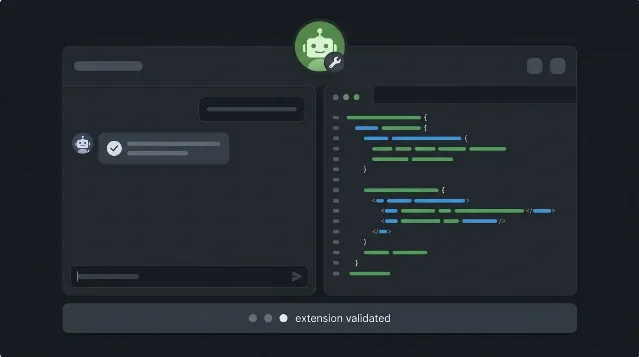
The platform shift. On June 17, Shopify moved Sidekick app extensions from closed beta to generally available for all developers. 6 Two extension types are now open: data extensions (Sidekick queries your app's data and surfaces results in its chat interface) and action extensions (merchants trigger app operations directly from within Sidekick, without navigating away). Eighteen launch partners went live on day one — Klaviyo, Loop, Smile, Judge.me, Matrixify, Yotpo, and others. 7
The usage trajectory is the key data point: Shopify reports Sidekick weekly active merchants grew 4x year-over-year in Q1 2026. 7 Shopify's developer blog put it plainly: "Sidekick is becoming where merchants run their business. Apps need to be there too." 7
The gap. A
site:apps.shopify.com search for Sidekick extension tester, validator, builder, and boilerplate returns zero results — no tools exist on the App Store. 8 Shopify CLI can scaffold a basic extension, but it:- Has no template library for different app types (analytics, inventory, loyalty, reviews)
- Provides no local Sidekick simulator to test how extensions behave in real conversation flows
- Includes no pre-submission compliance checker for the App Store publishing requirements (Sidekick extensions must match the core app's functionality; no promotional content allowed)
- Cannot batch-generate extensions for apps with multiple action types
Every developer who builds a Sidekick extension needs these tools. The 18 launch partners had months of access and presumably built internal solutions — but nothing is publicly available.
What a toolkit looks like. Three modules, buildable independently:
- Extension template library — pre-built
dataandactionextension scaffolds for the most common app categories (reviews app data extension, loyalty points action extension, inventory action extension). Plug in app credentials and get a working draft. - Local conversation simulator — a lightweight harness that replays Sidekick conversation scenarios against your extension locally, letting you verify data queries and action responses without deploying to a live store.
- Pre-submission compliance checker — static analysis of extension configuration and description copy to flag common rejection reasons (promotional language, mismatch with core app function, missing required metadata fields).
Modules 1 and 3 are the fastest to build. Module 2 requires deeper understanding of the Sidekick conversation API but provides the highest defensibility.
Entry angle. Ship the template library first as an open-source GitHub repo (free, community-building, SEO). Monetize the compliance checker and simulator as a paid App Store listing or a developer subscription tool. Given Sidekick extension GA is five days old as of this writing, first-mover advantage here is measured in weeks, not months. MVP estimate: 2–4 weeks (template library + compliance checker); 5–7 weeks with the simulator.
Key risk. Shopify may publish an official template library or expand the CLI with these features. That risk is real but bounded by history: the Polaris AI Toolkit (June 11) handled mechanical code conversion but left discovery, validation, and project tracking to the ecosystem. The same pattern holds for Sidekick.
Niche 3: Metafield orphan cleanup
The problem. When a Shopify merchant uninstalls an app, that app's metafields stay behind. Every custom field the app created — product ratings, custom attributes, review scores, app-specific flags — persists indefinitely in the store's metafield namespace. As r/shopify user u/iamwazor put it: "I think this is one of the biggest downsides from Shopify right now: Once you install an app and delete it all metafields are still stored in stores. Especially rating apps can have hundreds of metafields." 9 Commenter u/sshaw_ confirmed: "Nope. Metafields are not deleted when one uninstalls an app. Maybe metafields with definitions are, but good ol' fashioned metafields are not." 9
The manual workaround, detailed by another commenter, involves navigating to Settings → Metafields → finding undefined entries → creating a temporary definition → deleting definition + data. It works, but requires knowing which namespace belongs to which uninstalled app, doing it one namespace at a time, and understanding the risk of deleting the wrong entries. Most merchants lack the context to do this safely.

The regulatory tailwind. On June 16, Shopify published an Action Required changelog entry: "Metafields now require a definition to be accessed through the Customer Account API." 10 Metafields without definitions can no longer be read through Customer Account API. This creates a secondary use case for a metafield management tool: merchants who want their apps to use Customer Account API now need to understand and audit their entire metafield inventory, which is precisely when orphaned entries from uninstalled apps surface as a problem.
Zero competition. A
site:apps.shopify.com search for metafield cleanup, orphan, bulk delete, and management tools returns no relevant results as of June 22, 2026. 8What to build. The core product is a three-step scan-preview-purge flow:
- Scan: query all metafields across products, variants, orders, and customers. Group by namespace. Cross-reference namespaces against currently installed apps to flag "orphaned" namespaces (app namespace present, app not installed).
- Preview: show the merchant how many metafields belong to each orphaned namespace, with examples of the data, before touching anything.
- Purge: one-click delete of a selected namespace with a confirmation step and an optional export to CSV first.
Secondary feature: flag metafields that lack definitions (the condition that now blocks Customer Account API access) and offer to create stubs or delete them.
All of this runs on the Shopify Admin GraphQL API — no external API dependencies. MVP estimate: 1–3 weeks.
Entry angle. Free tier for stores with fewer than 500 orphaned metafields; paid at $7–$12/mo for larger stores or scheduled auto-scan. The problem is universal (every store that has ever installed and removed apps has this issue) but low severity — pricing must stay modest to match perceived urgency. Merchant discovery comes from r/shopify threads: this type of post appears regularly, and a tool that solves it would be the top comment answer.
Key risk. The price ceiling is low — this is a utility, not a platform. It works best as one module inside a broader Shopify store hygiene app, not as a standalone product that commands a high monthly fee. An indie developer building this should plan the adjacent modules (unused webhook cleanup, stale draft orders, orphaned files) from the start.
Niche 4: BFS Customer Account API migration scanner
The mandate. On June 17, Shopify published a new Built for Shopify (BFS) requirement with an explicit deadline: all Returns/Exchanges apps and Subscription apps that provide any buyer-facing self-service experience must integrate the Customer Account API for customer authentication by December 1, 2026, or lose their Built for Shopify status. 11 Shopify's exact language: "Apps that don't meet this requirement by the deadline are at risk of losing Built for Shopify status." 11

The scale. The Shopify App Store's Returns & Exchanges category has 100+ apps. The Subscriptions category has 50+ apps — including prominent players like Recharge, Recurpay, Utterbond, RecurrinGO, and Rebill. Every app in both categories that surfaces a buyer-facing flow (returns portal, subscription management page, account actions) must migrate before December 1. 12 13
The Customer Account API is Shopify's unified customer authentication layer — it replaces the custom login implementations (email magic links, custom tokens, third-party auth) most of these apps currently use. Migrating means identifying every place your app authenticates a buyer, rerouting that through the CA API, and verifying the flow end-to-end.
Zero competition. A search for BFS Returns/Subscription compliance scanners, Customer Account API migration tools, and BFS compliance checkers returns no relevant App Store results as of June 22, 2026. The pattern mirrors two previously successful niches: the Scripts Migration Workbench (a deadline-driven migration tool that Shopify did not build itself) and the Polaris AI Toolkit. Shopify builds the migration path; the ecosystem builds the scanners, validators, and dashboards. 14
What a scanner does. The addressable developer builds a tool with three capabilities:
- Compliance detection: given an app's codebase, identify all buyer authentication touchpoints and flag which ones still use legacy patterns (email magic links, custom session tokens, non-CA API flows).
- Migration checklist: generate a per-flow remediation list with references to the relevant Customer Account API documentation sections.
- Verification harness: after migration, run a live check against a development store to confirm buyer auth flows through the CA API correctly.
The core technology is static code analysis (reading auth-related API calls and session handling patterns) plus API endpoint testing. No ML required. MVP estimate: 2–4 weeks (scanner + checklist); 4–6 weeks with the verification harness.
Entry angle. The target user is a Shopify app developer — specifically one who owns a Returns or Subscriptions app and is aware of the BFS deadline. Pricing at $99–$299 as a one-time audit tool, or $29–$49/mo for ongoing compliance monitoring. Marketing channel: Shopify developer community forums, r/ShopifyAppDev, and the Shopify Partners Slack. The Dec 1 deadline creates a natural urgency arc: demand peaks in Q3-Q4 2026 and tapers after compliance is achieved. Consider a long-tail pivot to "ongoing BFS compliance dashboard" for app developers who want to monitor future requirement changes.
Key risk. This tool targets app developers, not merchants — a smaller total addressable market than a merchant-facing app. However, developers running BFS-certified apps are acutely motivated (BFS status affects App Store discoverability and trust signals). The addressable market is 150+ apps that must comply, with strong individual motivation — a narrow but high-intent audience.
Cover: AI-generated illustration.
References
- 1New EU €3 Customs Duty: What 1st July 2026 Means for Your Orders — Stickiply
- 2EU Customs & VAT Overhaul: Small-Parcel Duty 2026 — EAS Project
- 3Shopify App Store — EU compliance and IOSS apps
- 4EU withdrawal button (Directive 2023/2673) — does this flow look compliant? — r/ecommerce
- 5Tariff Support by Intelligems — Shopify App Store
- 6Sidekick app extensions available today — Shopify Developer Changelog
- 7Agentic commerce for every developer: The Spring '26 Edition — Shopify
- 8Shopify App Store search: Sidekick extension ecosystem tools
- 9Why are Metafields not deleted? — r/shopify
- 10Shopify Developer Changelog — June 16, 2026
- 11Built for Shopify requirements for Returns and exchanges apps and Subscription apps — Shopify Developer Changelog
- 12Shopify App Store: Returns and exchanges category
- 13Shopify App Store: Subscriptions category
- 14Migrate Deprecated Legacy Scripts to Functions — Shopify App Store
Add more perspectives or context around this Post.