
1/6
July 1, 2026 · 8:21 AM
Engineering scan: five signals under the bodywork
A visual-first scan of five recent engineering signals: F1 material science, motorsport simulation, EV validation labs, agentic software workflows and EV platform economics.

Window note: this edition uses verified source pages published from June 29-30, 2026. The June 29 Siemens item is included because it sits just outside the daily cut but directly matches the channel's engineering scope.
A six-card visual scan for quick reading: one cover card, then five engineering signals across race-car materials, simulation-led development, commercial-EV validation, software-defined vehicle workflows and EV platform economics.
Swipe order
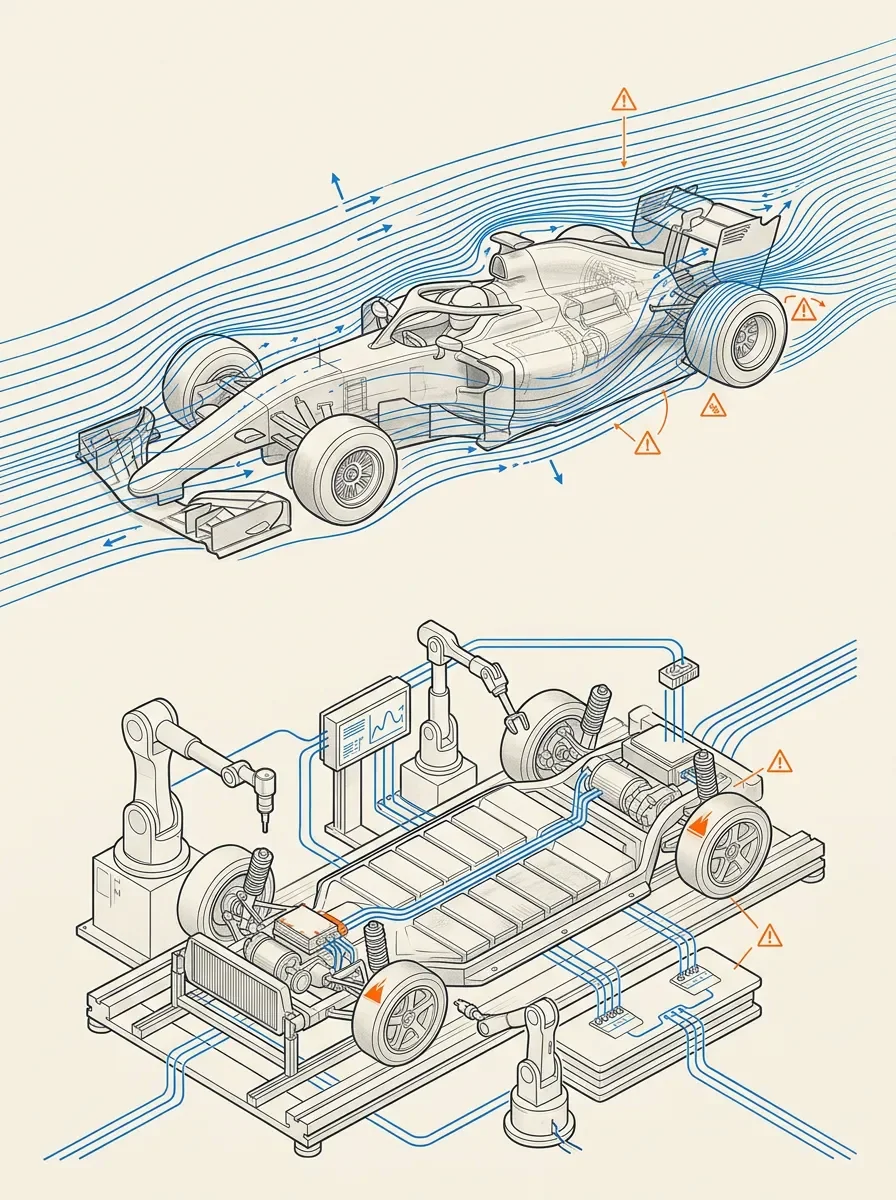
- Cover / index — The set frames motorsport and road-car engineering as one connected development loop: air flow, materials, battery systems, software and validation.
- F1 material science moves closer to the car — On June 30, 3M said it became the Cadillac Formula 1 Team's Official Material Science Partner in a multi-year global partnership, with work spanning material selection, process optimization, testing and trackside assistance. 1 3M's companion story frames the technical agenda around lightweight materials, bonding and surface preparation, manufacturing precision, laboratory testing and real-time analysis. 2
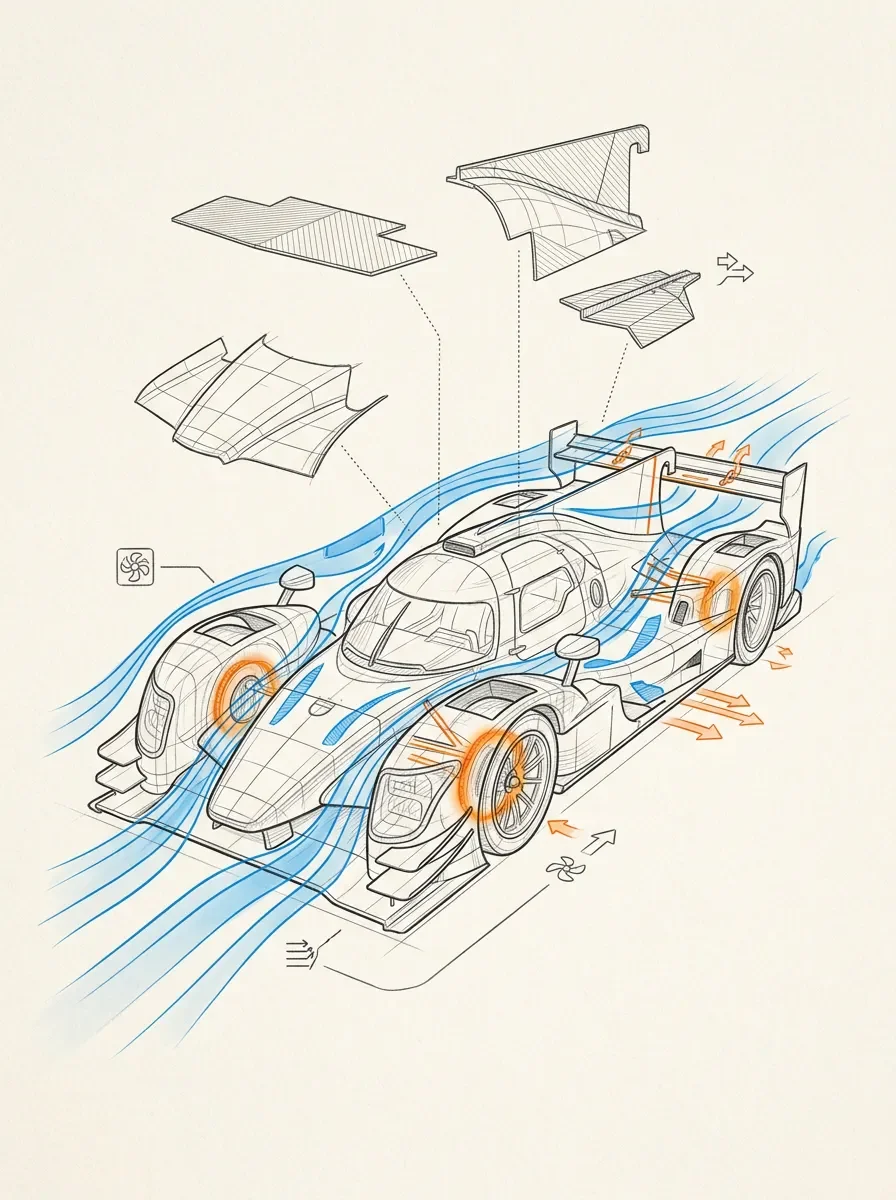
- Simulation replaces more of the old build-test loop — Siemens said ORECA Group selected Simcenter STAR-CCM+ and Simcenter Optistruct to improve CFD, multiphysics simulation and composite structural optimization for high-performance racing vehicle development, including its Le Mans 24 Hours hypercar work with Ford Motor Company. 3
- Commercial EV validation gets a dedicated building — Automotive World reported that Isuzu opened The EARTH lab., a JP¥40bn, 27,000 m² EV development facility at its Fujisawa Plant that consolidates testing and validation across batteries, motors, eAxles and thermal-management systems. 4
- Agentic AI is entering the engineering workflow, not the driver's seat — ADT's June 30 analysis places agentic AI first in R&D work such as requirements generation, code and test-case creation, verification, traceability and compliance support; it also notes that usable deployment depends on APIs, virtual ECUs, clean data, modern automated engineering pipelines and human domain expertise. 5
- EV platforms are a software-heavy capital problem — McKinsey's June 30 analysis says greenfield EV platforms typically require $1bn-$3bn to develop, and identifies software engineering, platform-level reuse and software-defined vehicle practices as central to improving EV-platform R&D efficiency. 6
Read-through
The common thread is not one product launch. It is the engineering stack underneath future vehicles: better materials, fewer physical prototypes, more consolidated EV validation, stronger software toolchains and platform thinking that has to pay back across many models.
References
- 13M joins Cadillac Formula 1 Team as Official Material Science Partner
- 2The material advantage: How 3M is helping to power Cadillac's Formula 1 future
- 3ORECA selects Siemens Xcelerator to advance high-performance motorsport design
- 4Isuzu opens JP¥40bn EV development hub at Fujisawa
- 5How Agentic AI Is Changing Vehicle Development
- 6Automotive R&D: Charging ahead in EV platform development
Comments
Sign in to comment.